




Pattern Grading VS Scaling
Pattern Grading
This process creates multiple sizes from a single sample-size sewing pattern, which is essential for ready-to-wear clothing.
How it works:
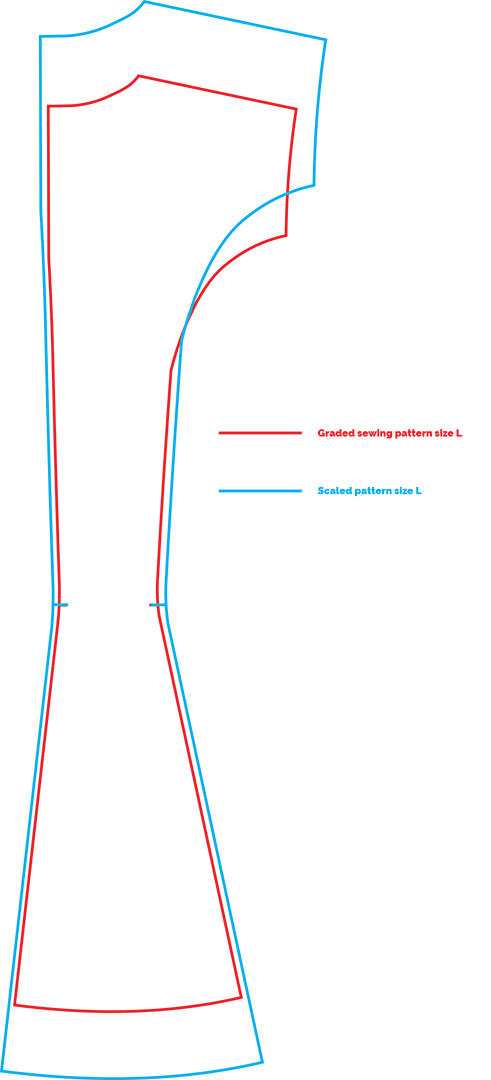
The pattern is enlarged or reduced by applying specific increases or decreases at various points (cardinal points). it's NOT sized on dimensions as shown in the illustration with a Red line.
Why it's necessary:
Bodies don't grow at the same rate in all areas, so simply drawing a larger line around the entire pattern isn't accurate.
Grading accounts for these different rates of change in measurements like the bust, waist, and hips.
Pattern Scaling
This process creates multiple sizes from a single prob pattern / blueprint, items that scale the same in all directions. Ignoring cardinal body points. it's sized on dimensions as shown in the illustration with a Blue line.
How it works:
Increasing or decreasing the size of an object by multiplying its dimensions by a scale factor greater than 1.
Ignoring various points (cardinal points).
Why it's not suited for sewing patterns:
Bodies don't grow at the same rate in all areas, so simply scaling a larger line around the entire pattern isn't accurate for body measurements. I would only recommend scaling props.
Conclusion:
Patterns that are made to wear on the body as sewing patterns can't be scaled, for a good fit they have to be graded. As shown in the illustration.